Heart Muscle Condition

Heart Failure (Congestive Heart Failure, CHF)

Heart failure means the heart is not pumping as well as it should, not that it has stopped or is about to. Just been told your heart is weak, or your ejection fraction is low? Sit down with Dr Paul Lim, who will take you through your results at your own pace and set out what treatment can do.

Dr Paul Lim Chun Yih Senior Consultant Cardiologist & Electrophysiologist
Dr Paul Lim Chun Yih, Senior Consultant Cardiologist and Electrophysiologist, Singapore
22+ Years of
Clinical Experience
Your Heart Specialist

Assessed by Dr Paul Lim

Senior Consultant Cardiologist & Cardiac Electrophysiologist

Dr Paul Lim subspecialises in the heart’s electrical system, which matters in heart failure more than people expect. Rhythm problems such as atrial fibrillation can weaken the heart, and a weakened heart is prone to dangerous rhythms. He implants the devices used in heart failure, defibrillators and resynchronisation pacemakers, where they are needed. He completed advanced fellowship training at Barts Heart Centre, London under Singapore’s HMDP award.

UK & SG Fellowship Training
10,000+ Patient Consultations
1,000+ Ablation & Device Procedures

The Basics

What Is Heart Failure?

Heart failure is when the heart cannot pump blood around the body as well as it should. It does not mean the heart has stopped working, or is about to. The muscle has become weaker, or stiffer, so less blood reaches your organs and muscles with each beat and pressure builds up behind it.

Congestive describes that build-up. Fluid the heart cannot move on collects in the lungs, which makes you breathless, and in the legs and abdomen, which swell. Congestive heart failure, CHF and cardiac failure all name the same condition.

The pump can fail in two broad ways:

  • It squeezes weakly. Less blood is pushed out with each beat. This is heart failure with reduced ejection fraction.
  • It squeezes normally but is stiff, so it does not relax and fill properly between beats. This is heart failure with preserved ejection fraction.

A smaller group falls between the two, with mildly reduced ejection fraction.

Doctors also talk about the side affected. Left-sided failure backs fluid up into the lungs; right-sided failure backs it up into the body, which is where swollen ankles come from. Many people have both.

Heart failure is not a heart attack

A heart attack is a blocked artery cutting off blood to part of the heart muscle. A cardiac arrest is the heart suddenly stopping. Both are emergencies, and both need 995. Heart failure is a longer-term weakness of the pump, though the three are linked: a heart attack is one of the commonest causes of heart failure, usually through coronary artery disease.

Your Echo Report

Ejection Fraction: The Number That Sorts Heart Failure

Ejection fraction (EF, or LVEF) is the share of blood the main pumping chamber pushes out with each beat. It is measured on an echocardiogram and printed on the report as a percentage. A healthy heart does not empty completely: pushing out half or more is normal.

Normal pump EF 50% or more Half or more of the blood leaves with each beat
Weakened pump EF 40% or less Most of the blood stays behind after each beat
Illustrative. The dashed outline is the chamber when full; the red shape is how far it squeezes. The difference is the blood pushed out, and that share is the ejection fraction.
Ejection fraction ranges and the type of heart failure each one indicates
Ejection fraction Category What it means
50% or more Normal range. HFpEF if you also have heart failure symptoms and signs The squeeze is fine; the problem is a stiff heart that fills poorly
41 to 49% Mildly reduced (HFmrEF) Between the two, and often treated along the lines of reduced EF
40% or less Reduced (HFrEF) The pump is weak. This is where medicines have the strongest evidence
Was 40% or less, now above Improved (HFimpEF) The heart has recovered some strength, usually with treatment that still needs continuing

These are the ejection fraction categories used to classify heart failure. An EF of 35% or less is also the level at which a protective device comes into the discussion.

What It Feels Like

Heart Failure Symptoms

The symptoms of a failing heart usually build up over weeks or months, and they are easy to put down to age or being unfit. Most come from the same two things: too little blood reaching the body, and fluid backing up behind the heart.

  • Breathless on exertionStairs, a slope or a walk you used to manage now leave you short of breath.
  • Breathless lying flatNeeding extra pillows to sleep, or waking at night gasping for air.
  • Swollen ankles, feet or legsFluid swelling (oedema) that is worse by evening and can spread to the abdomen.
  • Sudden weight gainWeight going up over a few days is fluid, not fat, and a useful early warning.
  • Tiredness and weaknessOften the first thing people notice, and the easiest to blame on something else.
  • A cough at nightWorse lying down, from fluid in the lungs.
  • Frothy pink phlegm or severe breathlessnessA sign of fluid flooding the lungs. Call 995.

Breathlessness has many causes besides the heart. If it is your main symptom, the shortness of breath guide covers the others.

How Urgent Is It?

When to Worry About Heart Failure Symptoms

Emergency — Call 995 or go to A&E

Do not wait for an appointment if you have:

  • Severe breathlessness, gasping, or being unable to finish a sentence
  • Lips or skin turning pale, blue or grey
  • A cough bringing up frothy or pink-tinged phlegm
  • Chest pain, tightness or pressure
  • Fainting or collapse

Book a cardiologist appointment

Arrange a review soon if:

  • You are newly breathless on exertion or when lying flat
  • Your ankles stay swollen after a night’s sleep
  • Your weight has gone up over a few days for no obvious reason
  • A report says your heart is enlarged or your EF is reduced
  • You already have heart failure and your symptoms are getting worse
  • A close relative has cardiomyopathy or died suddenly under 50
  • You are concerned about a result, or would simply like a second opinion

Less likely to be urgent

Worth mentioning at a routine visit:

  • Ankle swelling after a long flight, a hot day or standing all day that has gone by morning
  • Known, stable heart failure with no change in how you feel

Not sure which column you fall into? Speak to a cardiologist rather than wait and see.

Dr Paul Lim

Told your heart is weak? Talk to our friendly Dr Paul Lim about what your echo shows.

How Advanced Is It?

Heart Failure Stages and Classes

Two scales describe heart failure. The NYHA class measures how much symptoms limit you day to day, and it can improve with treatment. The ACC/AHA stage describes how far the condition has developed.

New York Heart Association (NYHA) functional classes of heart failure
NYHA class When symptoms appear In everyday terms
Class IOnly with more than ordinary activityNormal life, symptoms on real exertion
Class IIWith ordinary activityBreathless climbing stairs or walking briskly
Class IIIWith minimal activityBreathless dressing or walking across a room
Class IVAt restSymptoms even sitting still

The ACC/AHA stages run in one direction, from risk to advanced disease:

  • Stage A, at risk. Risk factors such as high blood pressure or diabetes, but no heart damage and no symptoms.
  • Stage B, pre-heart failure. Changes in the heart, such as a lowered EF or thickened walls, with no symptoms yet.
  • Stage C, symptomatic. Current or past symptoms of heart failure.
  • Stage D, advanced. Symptoms that interfere with daily life or keep bringing you back to hospital despite full treatment.

Stage B is worth dwelling on. It shows up on an echocardiogram before any symptoms appear, and treatment started then aims to keep them away.

Why It Happens

What Causes Heart Failure?

Heart failure is the end result of something else that has strained or damaged the heart. Finding that cause matters, because some of them can be treated directly.

Damage to the heart muscle

  • Coronary artery disease and heart attacks. Muscle starved of blood, or scarred by a heart attack, pumps less well.
  • High blood pressure, which makes the heart pump against resistance for years until the walls thicken and stiffen
  • Myocarditis: inflammation of the muscle, often after a viral infection
  • Alcohol and some cancer treatments, both of which can damage the muscle directly

Heart rhythm problems

  • Atrial fibrillation. A fast, irregular rate kept up for months can weaken the muscle. With the rate controlled, that weakening is often reversible.
  • Other fast rhythms, including very frequent extra beats, can do the same
  • A very slow heart. Heart block can leave the heart beating too few times a minute to meet the body’s needs.

The muscle, the valves and the rest of the body

  • Cardiomyopathy, where the muscle itself is diseased, often through an inherited cause
  • Heart valve disease. A narrowed or leaking valve makes the heart work harder with every beat.
  • Chronic kidney disease, anaemia and thyroid problems, which add to the load

More than one cause is common, particularly in older people: high blood pressure, narrowed arteries and atrial fibrillation often arrive together.

When the Muscle Is the Problem

Cardiomyopathy

Cardiomyopathy is the general term for diseases of the heart muscle, where the chamber walls become stretched, thickened or stiff. It is one of the main routes into heart failure, and several types run in families.

  • Dilated cardiomyopathy. The walls stretch and thin, and the pump weakens. It usually shows as a reduced EF.
  • Hypertrophic cardiomyopathy (HCM). The walls thicken, leaving the chamber smaller and stiffer. When the thickening narrows the way out of the heart, it is called HOCM.
  • Arrhythmogenic cardiomyopathy, an inherited condition in which muscle is gradually replaced by fatty scar tissue
  • Restrictive cardiomyopathy: stiff walls that stop the heart filling properly
  • Takotsubo cardiomyopathy. A sudden, temporary weakening brought on by severe stress, sometimes called broken heart syndrome.

Two things set cardiomyopathy apart. Several types raise the risk of dangerous heart rhythms, so part of the assessment is judging whether a defibrillator is needed for protection. And because most types are inherited, a diagnosis in one person is a reason to check close relatives, who can then be monitored early.

An “enlarged heart” on an X-ray

Cardiomegaly, or an enlarged heart, is often first mentioned on a chest X-ray. It is a description rather than a diagnosis: the heart shadow looks larger than expected, which can reflect a stretched chamber, thickened walls, fluid around the heart, or simply how the picture was taken. An echocardiogram settles which, and whether the heart is pumping normally.

Getting a Diagnosis

How Heart Failure Is Diagnosed

The aim is to answer three questions: is it heart failure, which type is it, and what caused it.

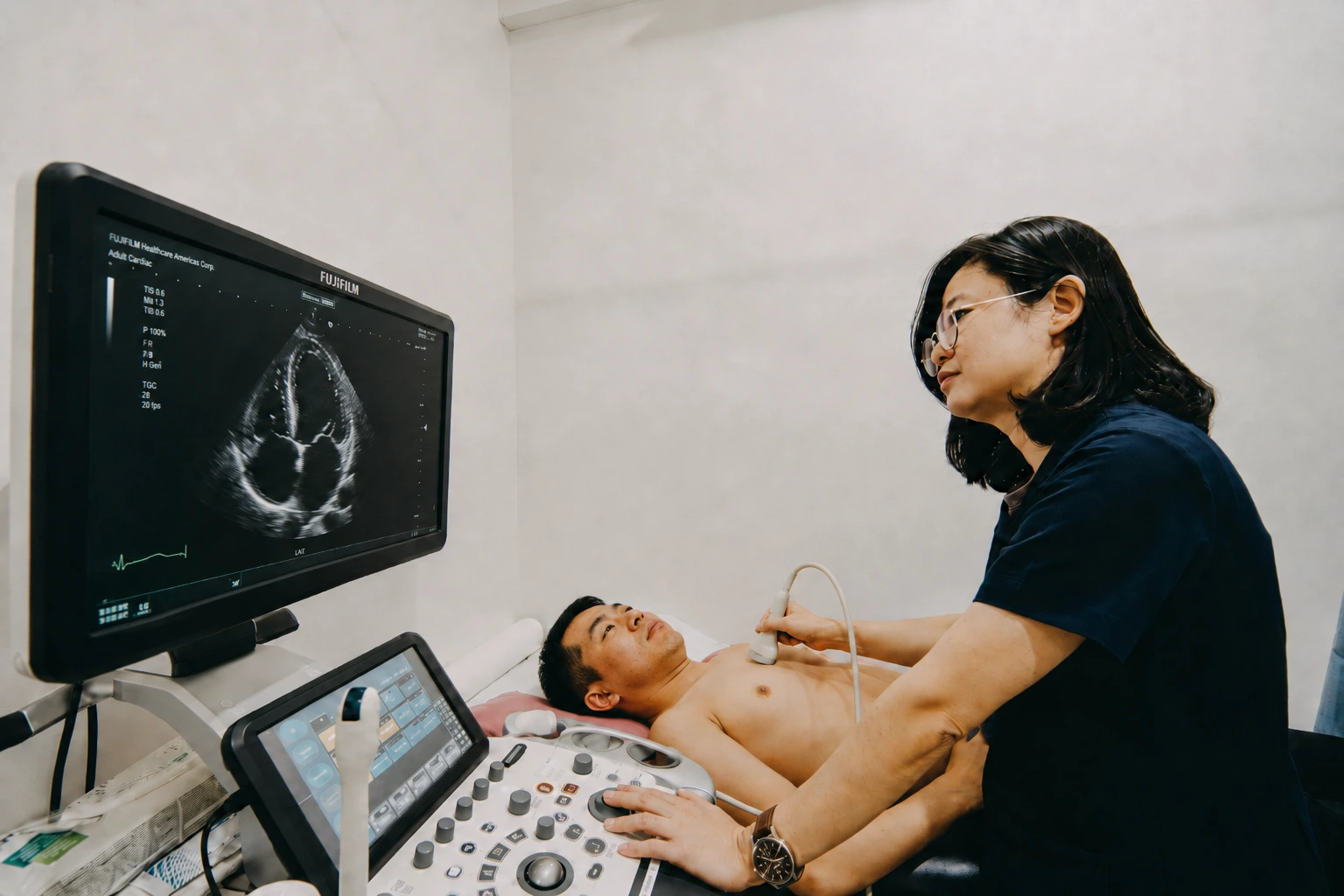
Female professional performing an echocardiogram, the ultrasound scan that measures ejection fraction
An echocardiogram measures the ejection fraction, and it is done in clinic.
  1. 1

    History and examination

    How far you can walk, how many pillows you sleep on, and whether your ankles swell. Fluid in the lungs and legs is often audible and visible, and every medicine you take is reviewed.

  2. 2

    Echocardiogram

    The key test. An ultrasound scan of the heart that measures the ejection fraction, the thickness of the walls, the size of the chambers and how the valves are working. It is painless and takes under an hour.

  3. 3

    Blood tests, including NT-proBNP

    NT-proBNP is a hormone the heart releases when it is under strain. It helps tell a heart cause of breathlessness from other causes, though it runs higher with age, kidney disease and atrial fibrillation, and lower with obesity. Kidney function, thyroid, blood count and sugar are checked alongside it.

  4. 4

    Electrocardiogram (ECG)

    Shows the rhythm, signs of a past heart attack, and whether a bundle branch block is present. A left bundle branch block matters here, because it is one of the findings that makes a resynchronisation device worth considering.

  5. 5

    Chest X-ray

    Shows fluid in or around the lungs and the size of the heart shadow.

  6. 6

    Tests to find the cause

    Depending on what the first tests show: a CT coronary angiogram or stress test to look at the arteries, a Holter monitor to catch a rhythm problem, or a cardiac MRI to look at the muscle itself.

Dr Paul Lim

The ECG, blood tests and echocardiogram are all done in clinic. Book a review with Dr Paul Lim.

Modern Care

Heart Failure Treatment

Heart failure usually cannot be cured, but treatment helps: it eases symptoms, keeps people out of hospital and helps them live longer. Most people need several of the approaches below together.

Self-care that makes a difference

Less salt, so the body holds on to less fluid. Weighing yourself every morning, since a rise over a few days is the earliest sign of fluid building up. Regular exercise, which improves how much you can do. Stopping smoking and keeping alcohol low.

Medicines that protect the heart

For reduced EF, four groups lower the risk of death and of hospital admission: an ARNI (sacubitril-valsartan) or an ACE inhibitor or ARB, a beta-blocker, a mineralocorticoid receptor antagonist, and an SGLT2 inhibitor, which helps whether or not you have diabetes. They are started low and built up over weeks. Never stop one on your own account.

Water tablets for fluid

Diuretics clear excess fluid from the lungs and legs, so they ease breathlessness and swelling quickly. The dose is adjusted to your weight and symptoms, which is where the daily weigh-in earns its keep.

Devices for a weak heart

If the EF stays at 35% or less despite several months of full medical treatment, an ICD guards against a dangerous rhythm by delivering a shock if one occurs. Where the ECG also shows a QRS of 130 ms or more with left bundle branch block, cardiac resynchronisation therapy (CRT) paces both sides of the heart back into step, which can improve symptoms and strength, with the strongest benefit seen at 150 ms or more. These are the devices Dr Lim implants, and the decision rests on your full picture, not one number.

Treating the cause

When a fast rhythm is weakening the heart, controlling it, sometimes with catheter ablation, can let the muscle recover. Narrowed arteries or a faulty valve are treated too, with the appropriate specialist where a procedure or surgery is needed.

Advanced treatment

For the small number whose heart failure stays severe despite everything else, a pump that assists the heart (a left ventricular assist device) or a heart transplant is considered at a specialist centre.

Day-to-Day

Living With Heart Failure

Much of what keeps heart failure stable happens at home, between appointments.

  • Weigh yourself every morningAfter the toilet and before breakfast, and write it down. Tell your doctor about a steady rise over a few days rather than waiting for the next visit.
  • Watch the saltSauces, stock, instant noodles and processed food carry most of it.
  • Drink what you are advised toSome people are given a daily fluid limit; others are not, so follow your own instructions.
  • Keep movingWalking most days helps, and a cardiac rehabilitation programme is a safe way to start.
  • Take every medicine as prescribedBring the full list to each appointment, and check with your doctor or pharmacist before starting anything new, including over-the-counter remedies.
  • Know your warning signsMore breathless, more swollen, or heavier than usual. Acting early often avoids a hospital stay.

Told Your Heart Is Weak?

Book a consultation with Dr Paul Lim to go through your echo result, find the cause, and agree a treatment plan.

Get in Touch

Book a Consultation for Heart Failure

See Dr Paul Lim about breathlessness, swelling or a low ejection fraction, and what can be done about it.

Send Us a Message

Visit Us

Where to Get Heart Failure Checked in Singapore

In the heart of Orchard

@ The Straits Eye Centre

1 Orchard Blvd, #06-07/08
Singapore 248649

Bringing heart-felt care to the community

@ ATA Medical Clinic (Jurong)

21 Jurong Gateway Rd, #02-07
Singapore 608546

Opening Hours

Monday – Friday8:30 AM – 5:30 PM
Saturday8:30 AM – 12:30 PM
Sunday & Public HolidaysClosed

By Appointment Only

Common Questions

Heart Failure FAQ

What is heart failure?

Heart failure means the heart cannot pump blood around the body as well as it should. It does not mean the heart has stopped, or is about to. The muscle has become weaker or stiffer, so less blood reaches the body with each beat and fluid can build up in the lungs and legs. It is also called congestive heart failure (CHF) or cardiac failure.

Is heart failure the same as a heart attack or cardiac arrest?

No. A heart attack is a blocked artery cutting off blood to part of the heart muscle, and a cardiac arrest is the heart suddenly stopping. Both are emergencies: call 995. Heart failure is a longer-term weakness of the pump. The three are linked, because a heart attack is one of the commonest causes of heart failure, and a weakened heart is more prone to dangerous rhythms.

What is the difference between HFrEF and HFpEF?

Both are heart failure, sorted by the ejection fraction on your echocardiogram. In heart failure with reduced ejection fraction (HFrEF) the EF is 40 per cent or less, because the muscle squeezes weakly. In heart failure with preserved ejection fraction (HFpEF) the EF is 50 per cent or more: the heart squeezes normally but is stiff and fills poorly. Mildly reduced EF, at 41 to 49 per cent, sits between them. The type matters because the medicines with the strongest evidence differ.

What are the stages of heart failure?

Two scales are used. The ACC/AHA stages run from A (at risk, with no symptoms or heart damage yet) through B (changes in the heart but no symptoms) and C (symptoms) to D (advanced heart failure despite treatment). The NYHA classes, I to IV, describe how much symptoms limit you, from breathlessness only with more than ordinary activity to symptoms at rest. Your NYHA class can improve with treatment.

Can heart failure be reversed or cured?

Heart failure usually cannot be cured, but treatment works: it relieves symptoms, lowers the chance of a hospital admission and helps people live longer. Some causes can be reversed. When a fast rhythm such as atrial fibrillation has weakened the heart, controlling the rate often lets the muscle recover. The ejection fraction can also climb with medicines, which is recorded as heart failure with improved ejection fraction.

How long can you live with heart failure?

That depends on the cause, the type of heart failure, how advanced it is and how well it responds to treatment. Medicines and devices that lower the risk of death are now standard care, and many people live with heart failure for years. Your own results are the best guide, so ask your cardiologist to go through what your echocardiogram shows and what it means for you.

What should I avoid eating or drinking with heart failure?

Cut down on salt, which makes the body hold on to fluid. Much of it comes from sauces, stock and eating out rather than the salt shaker. Keep alcohol low, since it can weaken the heart muscle directly. Some people are asked to limit how much they drink in total when fluid keeps building up. That is individual advice, so follow the amount your own doctor gives you rather than a general rule.

Is exercise safe with heart failure?

For most people it is, and it helps: regular exercise improves how much you can do and your quality of life. Start gently and build up, ideally through a supervised cardiac rehabilitation programme. Stop and seek help if activity brings on chest pain, dizziness or breathlessness well beyond your usual. Your cardiologist can tell you what level suits you.

Why does heart failure cause a cough or breathlessness when lying down?

When the heart cannot move blood on, pressure backs up into the lungs and fluid seeps into them. Lying flat lets more fluid shift towards the chest, so breathlessness is often worse in bed. People prop themselves up on extra pillows, and some wake at night gasping or coughing. A cough bringing up frothy, pink-tinged phlegm means fluid in the lungs and needs emergency care: call 995.

Can atrial fibrillation cause heart failure?

Yes, and the two often travel together. A fast, irregular heartbeat can weaken the heart muscle over time, and a weakened, stretched heart is more likely to go into atrial fibrillation. When the rhythm is the main driver, controlling it can let the heart recover. Treatment for atrial fibrillation is covered in its own guide.

Which doctor treats heart failure in Singapore?

Heart failure is diagnosed and managed by a cardiologist. Dr Paul Lim is a Senior Consultant Cardiologist and Electrophysiologist who assesses heart function with an echocardiogram, looks for rhythm problems that can weaken the heart, and implants the ICDs and resynchronisation devices used in heart failure. He sees patients at Orchard and Jurong.

WhatsApp Call Now